
By Halcyon Machinery · Published and reviewed
What should an automatic seam-recognition claim prove?
Ask which function acts before welding, which acts during welding, and what an inspected trial proves on your approved joint family. Finding a seam start point is different from following a changing seam during the weld. Neither a corrected robot path nor a sensor name is a completed weld-quality acceptance result.
Halcyon reviews equipment requirements with our factory team. This guide helps define a purchasing trial; it does not claim that a particular cell has passed it. Keep the joint drawing, fixture, proposed assistance system and inspection requirements together before comparing offers.
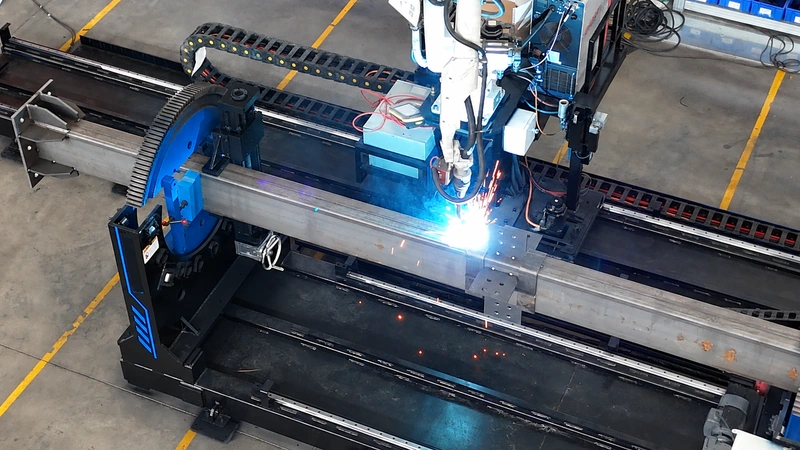
Separate three quotation functions
Pre-weld seam finding locates the joint before the welding pass. Ask what it measures, which reference it uses and how the result changes the planned path. Do not assume that locating endpoints also verifies the complete joint between them.
In-process seam tracking adjusts the path during welding for the deviations its specific system can detect. Ask about the proposed sensing method, supported joint geometry, process conditions and limits. A catalogue phrase such as “automatic recognition” does not identify all of those functions.
Post-weld inspection checks the completed result against the agreed acceptance criteria. Record it separately. Assistance may improve positioning, but it does not replace the required weld inspection or procedure review.
Fronius describes its TouchSense as a pre-weld locating function and its SeamTracking as a correction function during welding. This manufacturer example explains the distinction; it does not mean Fronius hardware, software or those capabilities are fitted to HWR-1240F or included in a Halcyon proposal.
Define the joint family before the demonstration
Provide the assembly and weld map, material grade, thickness, joint preparation, approved fit-up range, tack arrangement and fixture datums. Identify obstructed joints, changes of orientation and the ends or transitions that matter to your part. One accessible weld on a selected sample does not represent every connection.
Distinguish a change in joint position from a change in gap or edge alignment. Ask the integrator which conditions it detects, which it compensates for and which remain outside the proposed scope. Compensation limits must come from the documented system and the agreed welding procedure; do not apply a universal offset or gap tolerance.
Agree a traceable manufacturer-led trial
Use identified samples and a written plan approved by the responsible welding and integration specialists. Include the nominal setup and representative fit-up variation within the agreed procedure. Record the incoming condition independently so that a successful weld cannot be attributed to an undocumented manual adjustment.
Keep the part, fixture and program revisions with each sample. Identify the assistance function enabled for that run and retain the available detection or correction record. Where the controller cannot export a particular result, agree another documented observation and record that limitation. A video of robot movement alone is not a record of measured joint position.
| Trial question | Evidence to agree |
|---|---|
| What changed in the incoming part? | Sample ID, joint reference, measured fit-up and approved range. |
| What did seam finding locate? | Search result, reference frame, available record and path update. |
| What did tracking correct during welding? | Identified function, supported condition and available correction trace. |
| Was operator intervention required? | Adjustment, reason, time and sample affected; keep it visible in the record. |
| Did the weld pass inspection? | Inspection method, criteria, findings, responsible reviewer and disposition. |
| Was the result repeatable after reloading? | Later sample IDs, fixture reset, revised settings and reinspection. |
Include uncertainty and recovery in the written scope
Ask what the documented system does when it cannot locate the joint or when the signal is outside its supported condition. Who reviews the event, and how is a corrected or restarted sample identified? Agree any demonstration through our Xiamen production base's approved test procedure and safety controls. This guide does not instruct operators to bypass interlocks, obstruct a sensor or create a hazardous fault.
A completed pass with no visible alarm does not establish how unrecognized joints are handled. Keep unresolved conditions in the acceptance report rather than declaring that the system will always recover automatically. Changes to fixture, surface condition, joint preparation or program may require further review and trials.
Count a finished, inspected part
For the proposed part family, record locating time, welding time, loading, inspection, operator intervention and rework on a clearly stated basis. A shorter arc-on time can coexist with longer preparation or correction. Use accepted parts over the agreed timed run rather than treating sensor response speed or robot travel as finished output.
Keep failed samples and their inspection findings, then link the correction and repeat trial. Reset and reload the fixture for agreed repeat samples. A program replay on an unchanged demonstration piece does not test normal reloading variation.
Download a blank seam-sensing trial record (CSV). It contains headings only, without fabricated results or acceptance limits. Attach the approved drawing, procedure and inspection records.
Questions for a welding-cell proposal
Does touch sensing mean continuous seam tracking?
No. Require an explicit description of what operates before the weld and what operates during it, with evidence for your joint family.
Can the sensor make up for any fit-up error?
Do not assume it. Confirm supported conditions and limits against the specific system, fixture and welding procedure.
Does a tracking trace prove a sound weld?
It documents a control action. Weld acceptance still requires the agreed inspection and qualified review.
Send the joint and assistance scope together
Start with the robotic welding cell scope. For long members compare the structural-member station route; for intersecting connections compare the node workstation route. Those names do not establish sensor compatibility or weld acceptance.
Send the assembly, weld map, fit-up range and inspection requirements. We use them to discuss a named configuration and the evidence our factory team must provide.
Sources and review limits
HWR-1240F page describes a structural welding workstation and automatic seam recognition. It does not replace a configuration-specific trial. Fronius assistance-system documentation supplies the terminology example; its performance statements and catalogue specifications are not adopted as Halcyon guarantees.
Reviewed by Halcyon Machinery on 4 October 2026. The proposed trial plan is not a completed customer test, welding qualification or safety certification. No matching public Halcyon video has been verified as evidence of this sensing and inspection procedure.