
ERW Tube Mill & Welded Pipe Line
Define the section, weld-quality evidence and acceptance test before comparing a tube-mill proposal.
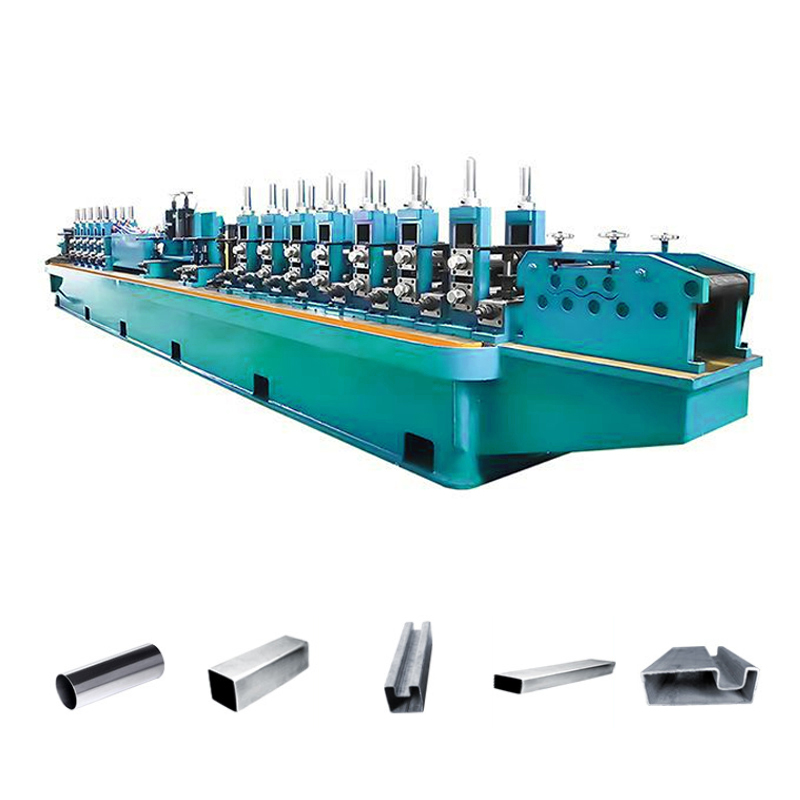
What should a welded tube mill proposal prove?
Buyer answer: Start with the finished tube drawing and service requirement. Ask our factory team to show how the forming, seam-welding, sizing and cut-off stages will be tested on your material. A machine name or a generic speed range cannot prove that your required tube and seam quality will be produced.
Halcyon reviews tube-line enquiries with our factory team. The proposed configuration and acceptance plan follow your finished tube specification.
Which stages appear in the third-party pipe-mill reference?
Our Xiamen production base's published high-frequency pipe-mill listing describes feeding, roll forming, high-frequency seam welding, cooling, cutting and control modules. It is a general product reference from our Xiamen production base, not a model-specific quotation, a full-line trial record or the weld quality required by your product standard. The photograph above shows only a forming-mill section.
If your request specifies an ERW tube mill, ask our factory team to identify the proposed welding method and power unit, the sizing and cut-off equipment actually included, and the inspection method for your approved tube and seam. Obtain a current line layout, module list, and first-off sample plan before comparing output claims. Do not infer that every tube size, material or weld standard is covered by the published reference.
ERW tube mill, welded tube mill or lock-seam former?
Match the search term to the seam-making operation. ERW means electric resistance welding; a request for an ERW tube mill needs a named welding method and the equipment that joins the strip edges. A supplier may use “welded tube mill”, “welded pipe mill” or “steel pipe making machine” for related production equipment, but the name alone does not establish the material, welding route or full line scope.
SRET's published ERW process overview identifies forming, longitudinal seam welding, sizing and cut-off as separate parts of its line. This is terminology and process context, not evidence that Halcyon supplies SRET equipment or that a proposed production-base line has passed inspection.
Does a lock-seam machine listing establish an ERW weld?
No. For example, our Xiamen production base's lock-seam listing describes custom profile forming, punching and cutting; that description does not identify an ERW welding unit or a seam-test result. Ask for the actual joining method and traceable finished-tube evidence rather than treating a closed-looking profile or a tube-forming photograph as proof of a welded seam.
Round, square and rectangular tube: confirm the production route
Submit a separate drawing and material schedule for every section. Ask our factory team to identify how the section is formed and sized, which roll sets and changeovers are included, and which weld and dimensional checks will be witnessed on the finished tube. Do not assume a round-pipe demonstration establishes square or rectangular tube capability.
Six items that make two tube-mill quotations comparable
- Entry and strip preparation: coil dimensions, strip condition, handling, end joining and any accumulator included in the quoted layout.
- Forming and sizing: section drawings, material range, roll sets and size-change procedure.
- Seam welding: named joining method, welding power-unit scope and agreed weld inspection criteria.
- Cut-off and finishing: finished length, edge and end requirements, straightness and equipment actually included.
- Accepted output: timed production with the agreed section/material mix, rejected lengths and changeover stops recorded.
- Handover record: current layout, equipment list, labelled samples and a signed inspection record for the proposed configuration.
Review coil loading and handling equipment when checking the entry and unloading scope. For cutting tubes that are already manufactured, compare the separate tube and profile laser-cutting equipment; downstream cutting does not manufacture or qualify a welded seam.
Inputs to send before a configuration is quoted
- ProductDimensioned round, square or rectangular tube drawing; length, intended use and applicable product standard.
- MaterialSteel grade, strip condition, thickness range, coil width and any surface or coating requirements.
- Seam requirementRequired weld inspection method, acceptance criteria and traceable sample record.
- Downstream workCut length, end treatment, straightness, packaging and any later punching or fabrication.
- Factory conditionsAvailable power, floor space, handling equipment, cooling provision and local safety requirements.
- Output targetRequired finished pieces or tonnes per shift and the material/size mix used to calculate it.
Acceptance evidence to request
Agree a first-off trial on the approved material and record the tube section at the start and end of the run, cut length, straightness, seam inspection result and any rejected pieces. If more than one size is being purchased, identify which changeovers must be witnessed and which tooling is included. The signed technical agreement should state the test sample, measurement method and acceptance threshold for each claimed value.
A roll formed open section, such as a C/Z purlin, has a different purchasing and inspection path. Compare its C/Z line requirements separately; do not infer welded-tube capability from a purlin-line photograph or performance figure.
Send us your specification
Send the tube drawing, material, seam requirements and output target. We will check the request with our factory team and confirm what evidence is still needed.
Get a quoteConfiguration follows a verified tube specification
Our factory team must review the product standard, strip and seam requirements before proposing tooling, welding, sizing, cut-off and handling. No line speed, size range, power or delivery promise is made on this page.
Submit a drawing for reviewProposal questions
- Which approved tube sizes need a witnessed trial?
- How will seam quality be inspected and recorded?
- What tooling and changeover work is included?
- Which cut-off and handling arrangement suits the finished length?
- Who confirms destination power and safety requirements?
What should I provide for a quotation?
Provide a dimensioned tube drawing, steel grade, strip thickness, intended product standard, seam acceptance method, finished lengths, output target, destination and plant utility details.
Does this page guarantee a tube size or production speed?
No. Our factory team must review your materials and product before those figures can be agreed in a signed technical specification.
Is a factory acceptance test available?
Ask for a written trial plan and measurement record in the proposal. Do not treat sample video or a generic catalogue as evidence that your exact tube has passed.
Download a welded pipe mill trial record
Keep the material, finished tube and inspection result traceable. Use the blank welded pipe mill trial worksheet (CSV) to link the proposed line revision, coil or strip ID, tube drawing and labelled sample to its dimensional measurements and seam inspection report. Record first-off, later-run and agreed changeover samples separately.
Before the trial, the buyer and our factory team should agree the applicable product standard, inspection procedure and acceptance criteria. Enter the actual report reference and result; a photograph of a closed tube is not a weld-inspection result. Record deviations, corrective action and any retest under new sample and report IDs so the review remains traceable.
For an output comparison, use accepted finished lengths divided by elapsed run minutes, including interruptions in the agreed trial period. Keep section, material, finished length and inspection conditions comparable. The sheet is blank: it contains no machine rating, test result or certificate and does not replace a qualified inspection report.
Send the completed evidence references with your tube drawing and configuration enquiry. Revised 2 October 2026.