
Corrugated Sheet Roll Forming Machine
Specify a sine-wave metal roof sheet line from the approved profile drawing, coil material and measured trial sheets.
Price range: corrugated sheet machines
US$20,000–29,000 (standard) · US$31,000–49,000 (premium), FOB China
Standard covers the first two configuration levels (single-profile and multi-profile / quick-change); premium covers fully automatic lines.
Final price depends on profile, thickness, speed, punching and automation. Excludes freight, import duties and installation. Send your profile drawing for a quotation within 24 hours. North American configurations (480V/60Hz, UL and local requirements) are quoted separately.
Large complete lines (e.g. truck chassis beam lines or full cable tray lines) are quoted per project, typically above US$150,000.
Manufactured in our Xiamen factory · 35+ years of roll forming experience.
Get a quote for this machine
Send your profile drawing or a photo of the profile. We reply within 24 hours with a configuration and price.
Commercial terms
- Lead time
- standard machines 30–60 days; automatic and heavy-duty lines 60–120 days (confirmed in the quotation).
- Warranty
- 12 months on the machine, lifetime technical support by video and remote guidance; wear parts excluded.
- Payment
- 30% deposit; 70% before shipment, after you approve the trial-run video.
- Shipping
- FOB Xiamen, China.
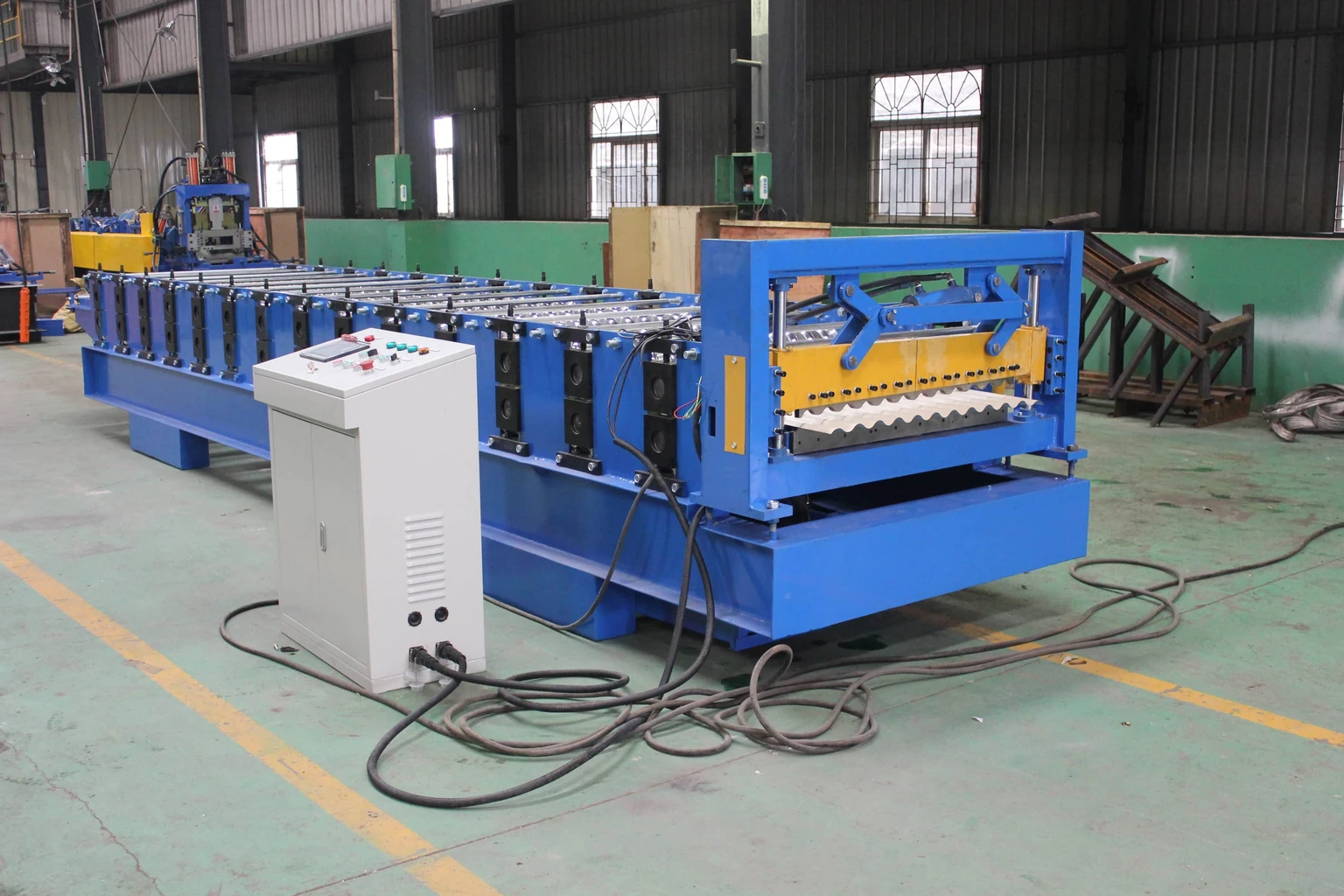
How should a buyer specify a corrugated sheet line?
Direct answer: Start with the approved sine-wave section drawing, not a catalogue speed. Confirm wave pitch and depth, sheet width before and after forming, effective cover, overlap direction and the coating that must remain acceptable after trial forming. Different corrugated patterns need different roll tooling.
- Profile inputdimensioned wave pitch, depth, edge geometry and allowable tolerances
- Material inputsteel grade, coating type, thickness range and coil width
- Output inputcut lengths, target output and stacking or handling needs
- Trial evidencefirst-off and repeat sheets checked for pitch, cover width, edge shape and cut squareness
Buying a corrugated iron roofing machine in Australia?
Buyer answer: In Australian searches, “corrugated iron” is a familiar roof-sheet term, but it does not specify the coil or the roll-forming tools. Ask for a corrugated iron sheet making machine quotation against the actual approved corrugated steel profile drawing: wave pitch and depth, overall and effective cover, lap edge, grade, coating, thickness range and cut length. Compare a labeled sample made from the proposed coil. A product name or photograph cannot prove that a line reproduces another supplier's proprietary sheet profile. For an example of why the exact profile and cover width matter, see Australian roofing manufacturer LYSAGHT's published corrugated roofing profile; that third-party product is a terminology and drawing reference, not a claimed Halcyon tooling approval or supplied sheet.
Do you need to form corrugations or curve an existing sheet?
A search for a “corrugated iron rolling machine” can describe different operations. For this roll-forming line, the input is flat coil and the proposed tooling forms the approved sine-wave cross-section before sheets are cut to length. Specify the wave pitch, depth, lap edges and material against that section drawing.
If the input is an already corrugated sheet and the required output has a curved roof or tank-wall shape, describe a separate curving operation: identify the existing section, material, sheet length and required radius or arc. Compare the roof panel curving machine scope against those drawings and request a trial of the proposed method. A crimped roof-panel example does not establish smooth-curving capability or suitability for every corrugated tank profile.
Send both the input-section drawing and the required finished shape through the technical enquiry form. Our factory team must confirm the tooling, forming or curving method, and acceptance evidence before a configuration is offered.
Does the roofing coil thickness mean BMT or TCT?
Buyer answer: State the thickness basis explicitly before comparing a corrugated sheet machine proposal. BMT means base metal thickness; TCT means total coated thickness. They are different material descriptors, not interchangeable machine settings. Australian roofing manufacturer Fielders lists BMT and TCT separately for its S-Rib corrugated product, with coating-specific notes. That table describes Fielders' sheet, not a Halcyon machine's material range or approval to reproduce its profile.
- Quotation: identify whether the stated thickness range is BMT or TCT, alongside steel grade, coating and coil width. Have our factory team confirm the same basis in the proposed scope.
- Trial: retain the coil identification and material documents; record the thickness basis and agreed measurement method with the labeled trial sheets.
- Comparison: resolve an unspecified basis before comparing two offers. Do not apply a universal BMT-to-TCT offset to every coating system.
Material terminology and buyer-check guidance reviewed 4 October 2026. Confirm the exact offered material and acceptance method with our factory team.
What determines a corrugated roll forming machine price?
Ask for an itemized offer against one approved corrugated drawing and material range. Compare the complete supply scope: a price for the forming section alone is not the same offer as a line that includes coil handling, cutting and sheet collection. Halcyon confirms the proposed configuration with our factory team before issuing a project quotation; this page does not publish a fixed price.
- Wave tooling: identify the wave pitch, depth, lap edges and number of approved profile drawings. Ask which tools are included and which additional profiles need a separate proposal.
- Coil and forming scope: list the decoiler and input limits, guides, roll stands and controls proposed for the stated steel, coating and thickness range.
- Cut and output handling: state the cut-length schedule, cutting arrangement, run-out supports and manual or automatic collection scope. Do not assume an automatic stacker is included.
- Acceptance and support: itemize trial material, measured sample records, installation assistance, training, spare parts and the exclusions agreed for the offer.
Keep the machine subtotal separate from packing, freight, destination import costs and any locally supplied services. Ask for the currency, quotation validity, delivery basis and proposed payment terms in writing. These are fields to confirm with the supplier, not costs or contractual terms promised here.
If two offers differ, first identify the missing modules and acceptance conditions; then compare totals on the same basis. Use the machine quotation comparison guide and its blank price-scope worksheet. Send your drawing, material and length schedule through the technical enquiry form for a matched proposal.
How should the wave and overlap trial be recorded?
Use the blank corrugated sheet trial record to connect the offered configuration and drawing revision to the identified coil, first-off and repeat sheets, and adjacent sheet-pair measurements. Record the specified BMT or TCT basis, wave pitch and depth, lap-edge fit, effective cover, cut squareness and surface observations against the agreed measurement method and acceptance limits.
Fill the results from the actual trial; the worksheet contains no prefilled dimensions, tolerances or acceptance decisions. It does not verify the finished roof system. Send the completed record with the approved drawing and material documents through the configuration review form so our factory team can review deviations and any repeat trial.
What should a trial sample prove?
Measure several full-width sheets against one drawing revision. Check that adjacent sheets overlap as intended, the coating is not visibly damaged at the formed waves, and the cut ends remain suitable for installation. Agree the measurement method and acceptable limits before factory acceptance; a photograph alone does not establish performance.
Compare this profile with the trapezoidal roof machine when rib geometry or effective cover drives the project choice. Send the drawing, steel grade, thickness range, punching layout if any, and target output for a configuration review with our factory team.
Send us your profile drawing
We will review your profile drawing, material, hole pattern and target output with our factory team before confirming the proposed scope and quotation.
Get a quoteCheck the wave and the overlap together
Keep the approved section drawing and labeled first-off and repeat sheets. Measure wave pitch, depth, total and effective cover, edge geometry and cut squareness. Place adjacent sheets together to check the intended overlap before accepting the tooling.
Send the corrugated profile drawingProposal questions
- Which coil grade and coating are tested?
- How is the effective cover measured?
- How are coating marks and cut edges recorded?
- What stacking or handling is in scope?
- Who approves the trial tolerances?
Can a trapezoidal line make a sine-wave corrugated sheet?
Only the proposed tooling and trial against both drawings can establish any shared machine scope. Do not infer this from the common label “roof sheet.”
Does a sheet sample prove roof performance?
No. The roof designer remains responsible for the complete fastening, overlap, water and structural requirements.
Are published line speeds guaranteed?
No. Output must be agreed against the approved profile, material, cut length and acceptance method in a signed technical scope.
Source and limit: Halcyon Machinery drawing and trial-review method, updated 4 October 2026. Our Xiamen production base publishes a corrugated forming-line example. Its catalogue setup is a reference, not the quoted line or evidence that the proposed tools match your sine-wave drawing. Confirm the actual machine scope and accepted trial sheets in writing.
Before comparing proposals, use the corrugated versus trapezoidal tooling guide to separate profile geometry, tooling scope and trial-sheet requirements.