
Profile Punching Machine for Roll-Formed Steel Sections
Specify hole geometry and inspection before choosing an in-line or offline punching operation.
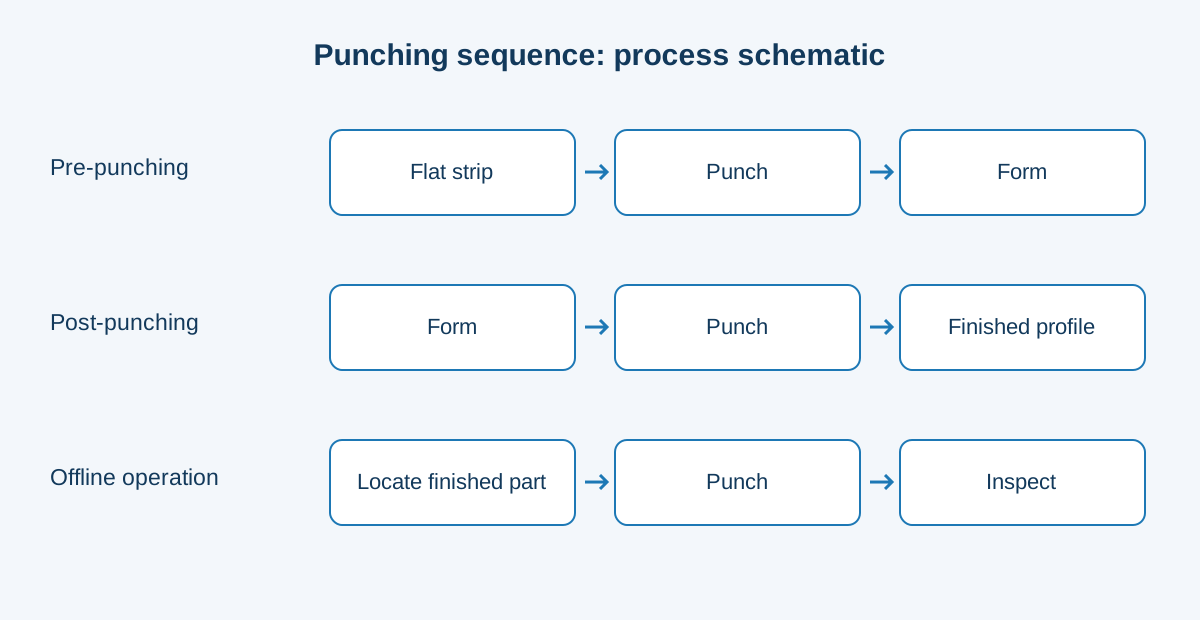
Should profile holes be punched in-line or offline?
Buyer answer: For roll-formed steel profiles, decide from the approved hole drawing and the existing production flow. In-line punching must work with the forming sequence, strip feed and control signals. Offline punching is a separate handling and locating operation. Neither option can be judged from a generic machine photograph or an unverified tonnage range.
Halcyon reviews punching requirements with our factory team. Identify whether the quotation covers a punch station, a separate part-punching machine or a coordinated forming line before comparing prices.
Are pre-punching and offline punching the same choice?
No. Pre-punching or post-punching describes whether the hole is made before or after the section is formed. In-line or offline describes whether punching is coordinated with the production line or performed as a separate handling operation. Specify both the process sequence and the integration scope.
For an in-line pre-punching system, ask our factory team to identify the strip preparation and feed, press and die set, pattern control, strip storage if required, scrap removal and interface with the forming line. For a separate machine, identify the finished-part supports, locating datum and handling cycle. Compare measured finished parts and accepted output under the same drawing and material conditions.
Use the coil-entry interface checklist and the blank pre/post-punch trial worksheet to retain the agreed scope and results. A system layout alone does not establish hole tolerance, absence of distortion or continuous output.
Define the hole and its datum
- Section drawingProfile geometry, steel grade, coating, thickness range and coil or finished-part dimensions.
- Hole drawingShape, size, pitch, edge distance, tolerance and reference datum for each profile.
- Production mixNumber of hole programs, changeovers, finished lengths and target output.
- Line interfaceExisting feed, stopping logic, encoder and PLC information if retrofitting an in-line station.
- Sample testFirst-off and repeat hole positions, burrs, deformation and mating-part fit.
Retrofitting an existing forming line
A retrofit requires our factory team to review the existing line drawings, control interface and safety arrangement. Ask whether the proposal includes mechanical mounting, die set, control changes, scrap handling and a witnessed trial on your own section. Do not assume the current PLC can accept an added unit without engineering review. For C/Z purlins, compare the profile and hole-layout requirements with the approved punching drawing.
Send us your section drawing
Send the section and hole drawings, material and current line details. Our factory team can then review the process and trial scope.
Get a quoteRequired force and tooling are application-specific
Our factory team must size tooling, force, station arrangement and controls from the approved material and hole plan. This page does not promise a tonnage, material envelope, line speed or retrofit compatibility.
Submit the hole drawingProposal questions
- Which datum is used to measure each hole?
- How are different patterns selected and verified?
- What causes burrs or profile distortion in the trial?
- How is scrap removed and guarding checked?
- What work is needed to connect the existing line?
What should I provide for a quotation?
Send the section and hole drawings, steel grade, thickness range, hole tolerances, output target and destination. For a retrofit, include existing line and PLC information.
Is hydraulic or servo punching better?
The answer depends on the hole program, material, cycle and line interface. Ask our factory team to compare both proposals against the same samples and measurement method.
Can you guarantee compatibility with our existing PLC?
Not without inspecting the control system and safety circuit. A retrofit scope must state who supplies the interface, programming and acceptance test.
Specify the punching sequence from the drawing
For holes or slots in a formed section, compare bend proximity, die access and measured trial parts. Review the pre-punch vs post-punch buyer guide. A press photo or catalogue label does not establish the configuration or acceptance result for your proposal.