
By Halcyon Machinery · Published and reviewed
Accept cut length against identified finished parts and the agreed drawing, not an encoder resolution or a controller display alone. Ask the machine manufacturer to document the proposed length-measurement arrangement, the measurement datum, the trial conditions and the actual results. A measuring-wheel specification is one part of that evidence; it is not a tolerance guarantee for a complete roll forming line.
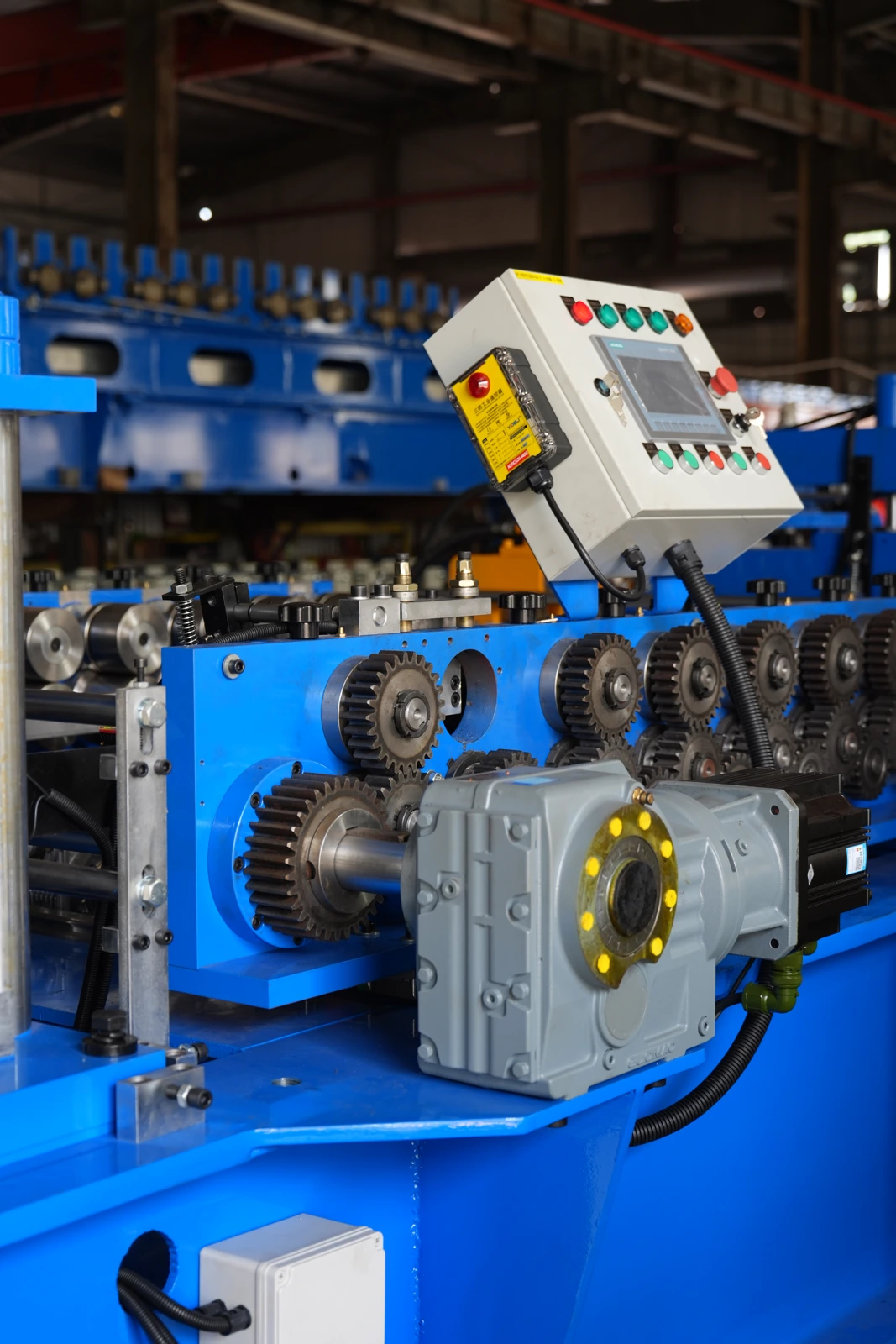
Separate the length signal from the finished part
A measuring wheel can transmit its rotation to an encoder as material travels beneath it. The component manufacturer abp explains that wheel surface and suitable contact matter to avoiding slip. This describes a measurement principle, not proof that a particular Halcyon proposal uses that component or achieves a particular accuracy.
Ask what the quoted line measures: incoming strip movement, a driven axis, formed material or another reference. Ask how that measurement relates to the finished part drawing. Do not assume that a displayed set length, an encoder count and a measured cut part represent the same acceptance result.
Define the drawing datum before running samples
Write down the nominal length, permitted deviation, reference faces and the method for measuring them. Where punched holes are involved, separate overall cut length from hole position relative to the agreed datum. A part can satisfy one requirement while failing another. Keep cut-end condition and straightness as separate observations rather than silently changing the length-measurement method to hide them.
Ask for evidence across the proposed operating conditions
The trial plan should identify material grade, coating, thickness, profile, target lengths and the production conditions being evaluated. Agree which samples represent initial setup, later production and restart after a planned stop. Retain their individual results. An average alone does not show whether each accepted sample meets its limit.
If the proposal includes moving cut-off equipment, ask our factory team how the measurement reference and cutting motion are coordinated. Beckhoff describes synchronization of a flying-saw axis with a moving master axis. That is an external controls example, not confirmation of the controller installed in a Halcyon line or of its resulting cut accuracy.
What to retain in the trial record
- Drawing revision, length datum, acceptance limit and measurement method.
- Material and profile identification, including the ordered thickness range.
- Manufacturer description of the proposed measurement and cut-off arrangement.
- Sample ID, commanded length, independently measured length and deviation.
- Initial-run, later-run and restart identification where included in the agreed plan.
- Cut-end condition, punching position and separate dimensional results where required.
- Any supplier adjustment, followed by separately identified verification samples.
This is a procurement evidence checklist, not an instruction to change wheel pressure, encoder scaling, compensation values or safety systems. The manufacturer should supply the approved setup and investigation procedure for the specific machine.
Download the blank cut-length acceptance record. This worksheet contains no machine results or default tolerance.
Questions buyers ask
Does more encoder resolution guarantee a smaller finished-part deviation?
No. Resolution describes the signal system. Accept the proposed machine on measured parts under documented trial conditions, including the agreed material and production sequence.
Can a supplier use one correction for every material and length?
Ask the supplier to demonstrate the stated operating range and explain the approved method. Do not accept a universal correction or accuracy promise without evidence covering your order.
What should I send for a quotation?
Send the section drawing, length range, steel grade, coating and thickness range. Include punching datums, the required length limits and your intended sample-inspection method. Halcyon Machinery reviews the requirements with our factory team; configuration and achievable acceptance limits require supplier-specific confirmation.
Sources and related reading
Technical principle references: abp measuring wheels and Beckhoff flying-saw synchronization. Neither reference is evidence of Halcyon component supply or machine performance.
Review the complete cut-off station; prepare the line quotation requirements. Reviewed: 3 October 2026.