
By Halcyon Machinery · Published and reviewed
Direct answer for a gutter-line buyer
Approve the cut end against the gutter drawing and the fitting that actually uses that end. Check finished length, the specified end plane, profile opening and visible edge condition on an identified sample after it leaves the cutting tool. A correct length reading does not establish that an end cap, connector or other specified fitting will seat correctly.
Halcyon carries out configuration reviews with our factory team. This is a buyer's trial framework, not a completed machine test. The intended gutter shape, material, cutting method and acceptance limits belong in the agreed specification.
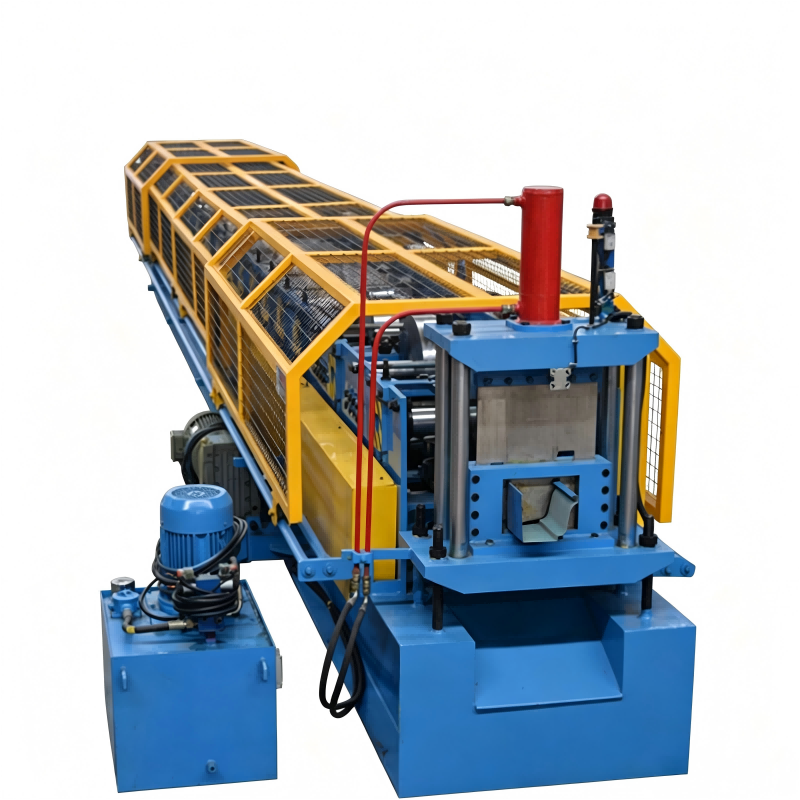
Identify the component that the cut must serve
Send the gutter section together with the drawing of any end cap, splice, outlet or other mating component affected by the cut. Specify whether a connector surrounds the outside, engages the inside or relies on a particular hem or flange. Do not assume every gutter system uses the same connection or that all fittings are supplied by the roll-forming line.
Ask which operation produces the relevant features: the line's cut-off, a separate punching or trimming station, another fabrication process or a purchased fitting. Mark exclusions in the equipment list. A gutter profile alone does not define a complete fitting package.
Distinguish the end from the profile farther along the piece
Measure the drawing-defined opening, side positions and critical hem or flange features at agreed locations near each end and farther into the sample. Use the same datum and support conditions. This helps separate a local cut-end issue from a profile that is incorrect throughout its length.
Inspect the piece after release from the tool; holding it tightly inside the cutter can conceal the shape that the fitting encounters. Record which end was inspected and its position in the trial sequence. Do not force a fitting onto the sample before measuring it and then use the altered section as the original result.
Check length and the end plane separately
Agree the length reference points and the required end geometry. A sloped or distorted end can give different readings on opposite sides of a shaped gutter. If a perpendicular end is required, state its datum and agreed measurement method; another drawing may intentionally require an angled cut.
Keep the machine setting, actual length readings and end-geometry results in separate fields. Do not transfer a catalogue length tolerance to burrs, opening dimensions or fitting engagement. Each required feature needs its own acceptance criterion.
| Trial check | Evidence to retain |
|---|---|
| Sample identity | Drawing revision, sample ID, coil or material batch, grade, coating and thickness. |
| Cutting setup | Quoted cutting method, tool identity, recorded settings and sequence. |
| Length and end plane | Measurement datums, instruments, readings at the agreed locations and drawing limits. |
| Local section | Opening, hem or flange readings near the ends and at agreed comparison positions. |
| Visible edge | Location and photographs of burrs, distortion and visible coating damage. |
| Fitting trial | Mating-part identity, drawing revision, preparation condition and fit result. |
| Repeat trial | First-off and later samples, rejected pieces, adjustments and retest IDs. |
Record edge preparation before testing the fitting
Examine the accessible cut edges and visible coating condition using the agreed inspection procedure. If burr height or another edge feature is a contractual requirement, agree its measurement method and limit. A photograph can locate a defect but does not replace a specified dimensional measurement.
If the accepted production route includes deburring, trimming or other preparation, identify that operation and who supplies it. Record the as-cut result and the result after the agreed preparation separately. Do not present a specially prepared sample as proof that every piece comes off the line ready for assembly.
Use the real mating part and retain repeat results
Try the specified fitting with the agreed assembly procedure and record its identity. Check the drawing-defined seating, engagement and alignment without silently changing the gutter or fitting. Identify any force, fixture or adjustment used. Whether the fit is acceptable is determined by the approved design, not by how attractive the sample looks.
Agree a representative sample plan for the sections, materials and lengths in the offer. Include first-off and later pieces and identify relevant setup changes. Retain failures with the corrective action and repeat results. One selected end cap that fits one selected sample does not demonstrate the whole production range.
Download the blank gutter cut-end trial record (CSV). It contains headings only, without fictional results or suggested tolerances.
What this trial cannot prove
A cut-end and fitting trial checks the agreed manufacturing and assembly features. It does not establish rainfall capacity, watertightness in service or building-code compliance. Those require the project's design and applicable system evidence. It also does not establish portable production, every gutter shape or automatic fitting manufacture.
Buyer questions
Can the gutter pass length inspection but fail the fitting trial?
Yes. Length, local section, edge condition and the mating interface are different checks. Record each required feature against its own agreed criterion.
Must an end cap be made by the gutter machine?
No such scope is assumed. The proposal should identify whether the fitting is made separately or purchased and which trial proves the interface.
What should I send before the supplier prepares a trial?
Send the gutter and mating-part drawings, material and coating, thickness and lengths, required preparation steps, measurement criteria and representative order mix.
Review the gutter roll-forming equipment scope. For production location, use the separate factory versus portable gutter-machine guide; for another component, check downspout elbow scope. Send your gutter and fitting drawings for configuration review.
Source and review boundary
Our Xiamen production base's published HGT-115 gutter-machine listing identifies the reference equipment family and post-cutting method. Its numerical catalogue claims are not adopted as a Halcyon quotation. The cut-end procedure above is Halcyon's buyer-review framework, not a supplier test report. No matching public Halcyon video of this cut-end measurement and fitting trial has been verified.