
Glazed Tile Roll Forming Machine
Step tile and glazed tile roofing profiles — the coloured steel roof that looks like clay.
Price range: glazed tile (step tile) machines
US$21,000–31,000 (standard) · US$34,000–55,000 (premium), FOB China
Standard covers the first two configuration levels (single-profile and multi-profile / quick-change); premium covers fully automatic lines.
Final price depends on profile, thickness, speed, punching and automation. Excludes freight, import duties and installation. Send your profile drawing for a quotation within 24 hours. North American configurations (480V/60Hz, UL and local requirements) are quoted separately.
Large complete lines (e.g. truck chassis beam lines or full cable tray lines) are quoted per project, typically above US$150,000.
Manufactured in our Xiamen factory · 35+ years of roll forming experience.
Profiles this machine can make
Illustrative sections. Your machine is configured to your own profile drawing.
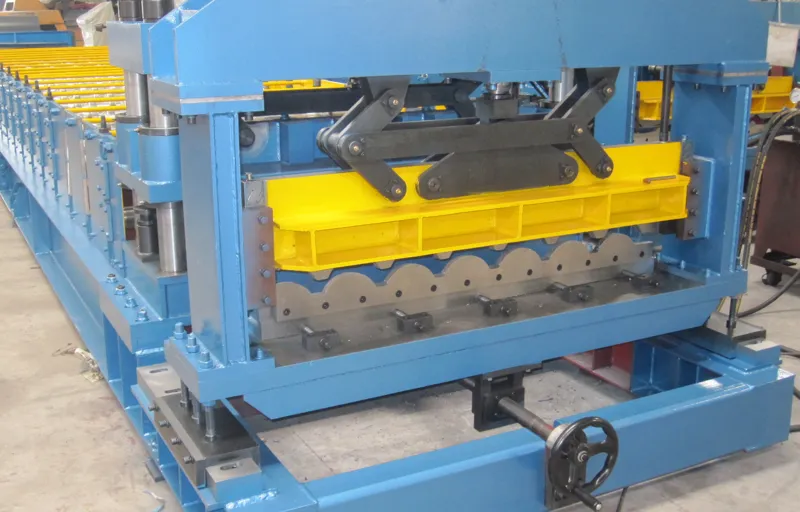 Factory photo
Step tile / metal roof tile
- Size
- 0.4–0.6 mm pre-painted or galvanized steel; step pitch and height to your drawing
- Use
- Pitched roofs of houses and villas
- Changeover
- Fixed profile; the step is pressed by a hydraulic die set to your pitch.
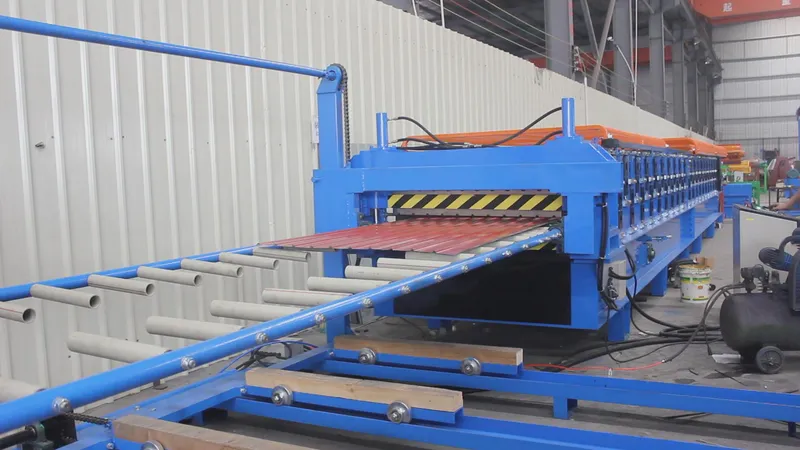 Factory photo
Tile + trapezoidal on one machine
- Size
- To your drawing
- Use
- Two products from a small workshop
- Changeover
- Double-layer machine: two profiles on two levels. See machine →
Get a quote for this machine
Send your profile drawing or a photo of the profile. We reply within 24 hours with a configuration and price.
Commercial terms
- Lead time
- standard machines 30–60 days; automatic and heavy-duty lines 60–120 days (confirmed in the quotation).
- Warranty
- 12 months on the machine, lifetime technical support by video and remote guidance; wear parts excluded.
- Payment
- 30% deposit; 70% before shipment, after you approve the trial-run video.
- Shipping
- FOB Xiamen, China.
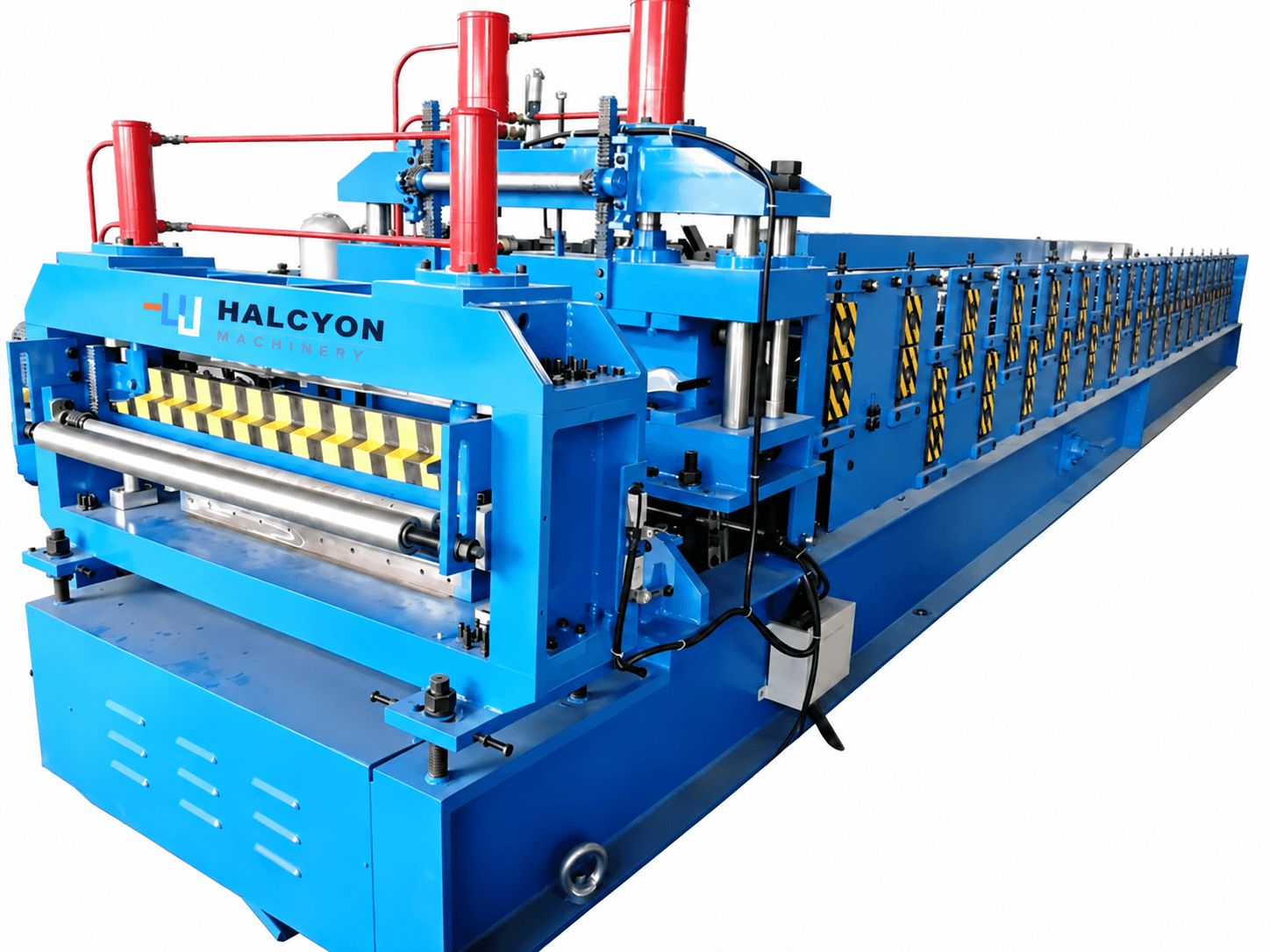
What makes a step-tile line different?
Direct answer: The visible tile step must repeat at the drawing's pitch and line up across the intended end lap. A buyer should specify the section and step pattern together, then inspect formed samples for repeatability, effective cover and coating condition. A generic line-speed figure does not prove these outcomes.
- Drawing inputtile-step pitch and height, pan and rib geometry, effective cover and lap direction
- Material inputgrade, coating, thickness range and coil width
- Cut requirementfinished lengths and intended alignment of step and end lap
- Trial evidencemultiple sheets checked for step spacing, joined appearance, cut position and coating damage
Published reference: forming speed versus finished output
Our Xiamen production base's glazed tile roll forming machine listing gives the following configuration. These are reference values for that published line, not confirmed specifications for every Halcyon quotation. Ask our factory team to identify the offered machine and drawing revision.
| Buyer check | Published production-base reference | What to confirm in the proposal |
|---|---|---|
| Coil material | Pre-painted or galvanized steel; 0.4–0.6 mm; 235 MPa yield strength | Confirm grade, coating and thickness range on the trial coil. |
| Speed basis | About 10 m/min forming speed; 0–3 m/min output speed | Record finished accepted sheets per timed run, including step pressing, cutting and handling. |
| Drive and tooling | Chain drive; No.45 forged-steel rollers | Confirm tooling for the approved rib and tile-step drawing; no universal roller-life claim. |
| Cut and measurement | Hydraulic cut; Cr12 cutter; encoder length measurement | Agree cut position relative to the first step and inspect first-off and later sheets. |
| Control and motors | Mitsubishi PLC; 5.5 kW main motor and 5.5 kW hydraulic-station motor | Confirm proposed components, electrical supply and operating instructions. |
Step pitch, sheet length and the pressing/cutting cycle must be recorded with the output result. A continuous forming-speed figure cannot by itself establish finished-sheet productivity. Roof weather performance and load capacity require separate system and project evidence.
Check coil loading and finished-sheet handling against the decoiler and stacker requirements. If a plain rib sheet is also required, compare a double-layer roll forming line; require separate trials for each proposed profile.
Where is this profile suitable?
It is considered when a project requires the appearance of a stepped tile sheet. Suitability for a particular roof, span, fixing pattern or local code must be established from the building design and material specification; the machine trial only validates the produced profile.
Send the profile drawing, steel grade, thickness range, any punching layout and target output. For a plain ribbed sheet, compare the trapezoidal roof option before selecting tooling.
Send us your profile drawing
We will review your profile drawing, material, hole pattern and target output with our factory team before confirming the proposed scope and quotation.
Get a quoteStep-tile trial: check the repeating pattern
Identify the drawing revision and trial coil, then retain first-off and later sheets. Measure step pitch, step height, pan and rib positions, cut location and effective cover at agreed reference points. Place sheets together in the intended lap direction to assess the visible pattern and inspect the coating for marks.
Does a tile-like appearance prove roof-system performance?
No. Forming trials check the produced sheet. Wind resistance, weather tightness, fixing and local-code suitability belong to the project design and any required system tests.
What changes the forming proposal?
Step geometry, coating and steel grade, thickness range, coil width, cut length, punching requirement and target output may change tooling and handling. Our factory team must document the offered configuration.
Source and limits: Halcyon Machinery buyer-review framework, updated 2 October 2026. No universal speed, structural performance or certified roof-system result is claimed.
Check sheet ends when order lengths change
Overall length alone does not establish the first and last step positions. Use the step-tile order-length and end-allowance guide to build a drawing-based order matrix and trial record.