
By Halcyon Machinery · Published and reviewed
Can a CNC sheet metal folding machine complete your flashing?
Request a complete-part trial showing every bend, repositioning step and final removal using your drawing, material and the tooling actually quoted. Maximum working length, throat depth and material capacity do not establish that a finished return flange will clear the machine throughout its bend sequence.
Halcyon Machinery reviews equipment requirements with our factory team. This guide concerns the purchase review of a beam-style sheet metal folding machine for flashings and trims. It does not give an operating sequence for an unverified part or confirm that any quoted build has passed a trial.
Define the finished section before discussing the sequence
Send the finished cross-section, part length, material specification, surface finish and drawing revision. Mark the side that must remain visible after installation. Identify return flanges, opposing bends, hems and any ends that need extra processing. Include the proposed flat blank as a separate document, with its calculation assumptions and revision.
A two-dimensional outline alone can omit end details or the shape after an intermediate bend. Add end views or a three-dimensional model when they clarify the part. Keep inside bend radius, flange dimensions and angular conventions explicit: a machine's displayed bend setting may not use the same convention as the finished drawing. Do not change the design merely to make an unreviewed sequence appear possible.
Why an already formed flange changes the clearance question
For each operation, ask how the partially formed workpiece is clamped and located, where its existing flanges sit, and how it can move into and out of that position. A flange that clears during one operation can interfere with tooling, the clamping arrangement or another machine component in a later orientation. Record any reversal, rotation, manual regripping or support change.
Keep two questions separate: whether the planned bends can be made, and whether the finished part can be released and removed. For long flashings, request evidence of the actual support and handling arrangement as well as the cross-section. Access at a short demonstration piece does not prove access for the intended production length.
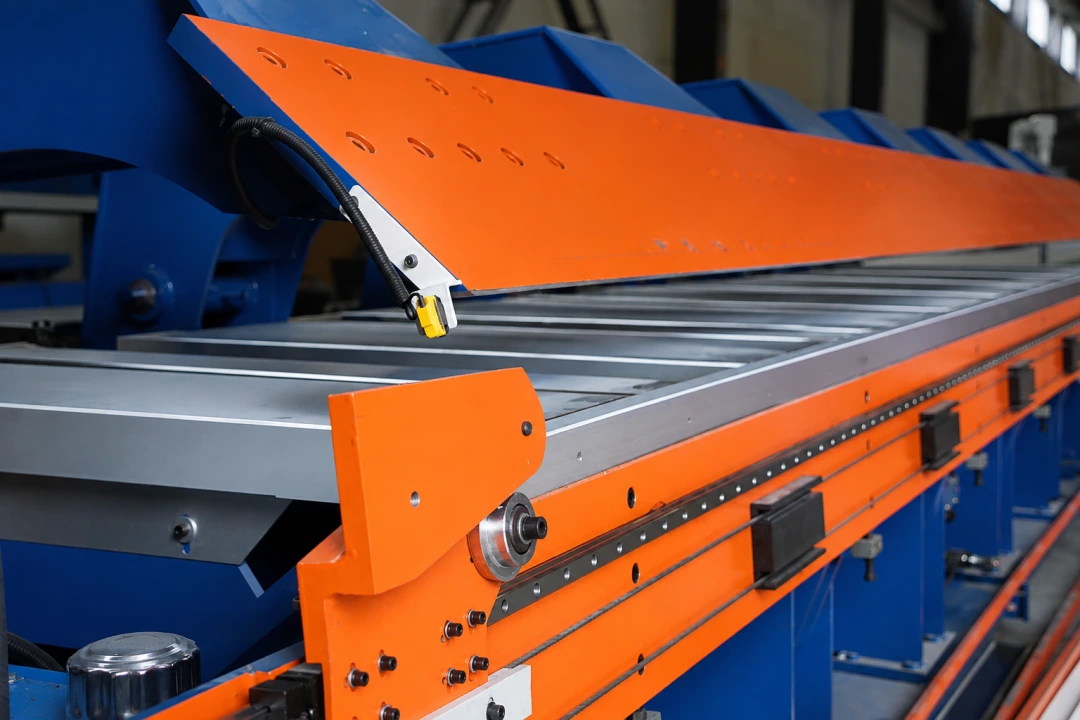

Ask for a bend-by-bend evidence record
| Purchase question | Evidence to request | Decision supported |
|---|---|---|
| Which tooling is being demonstrated? | Tool identification or drawings, machine configuration and quotation revision. | Whether the trial matches the equipment and accessories offered. |
| Where are existing flanges at each bend? | Numbered part views showing orientation, clamping and completed bends. | Whether the proposed sequence addresses the complete section. |
| What requires repositioning? | Continuous demonstration with reversals, regripping and support changes retained. | Actual handling scope, rather than an edited single-bend impression. |
| Can the completed part be removed? | Release and removal shown at the agreed finished length. | Whether the finished geometry can leave the demonstrated setup. |
| What remains outside the machine's scope? | Written exclusions for hems, end notches, corners, slitting or other operations. | Which additional tools, equipment or services the order needs. |
Distinguish a folding machine from a press-brake proposal
Equipment descriptions sometimes use “bending machine,” “folding machine” and “press brake” loosely. Ask the supplier to identify the actual forming mechanism and tools. A folding-beam demonstration cannot establish the capabilities of a punch-and-die press brake, or vice versa.
Our Xiamen production base's HFB-6500 reference page describes long-sheet bending and folding, a CNC program that generates operations and animated guidance. Those descriptions do not establish clearance for your particular flashing. Ask for the offered configuration and a complete-part demonstration; do not assume a software feature guarantees a feasible sequence.
Metalix's MBend documentation discusses bend sequencing and tooling-related collision considerations in its own CAD/CAM system. It is useful background for distinguishing a proposed sequence from a single finished outline. It does not mean MBend is supplied with HFB-6500 or that a press-brake simulation can certify a folding-machine setup.
Treat hems and closed returns as separate requests
If the drawing includes an open or closed hem, describe the required gap, radius, appearance and material. Ask what tool arrangement and additional operation the supplier proposes, and include that feature in the same trial. Do not infer hemming capability from a maximum bend-angle figure or a drawing stored on the controller.
Likewise, a sample with one simple return does not prove that several opposing returns, end flanges or a more enclosed section are achievable. Compare the actual part families you plan to sell, including their limiting features, rather than relying on the number of programs stored in the control.
Check the finished part after release
Record finished angles, flange dimensions, overall section and surface condition at agreed locations. Use the drawing's datums, units and acceptance limits. Record whether results were taken before or after release, and retain changes made between initial and repeat trials. Surface protection, support and handling belong in the evidence when appearance is a purchase requirement.
An illustrative comparison: one proposal shows a simple angle; another shows every operation of your return-flange flashing and its removal. These are different levels of evidence. The second record still needs measured results and a match to the quoted build. This example is not a Halcyon customer case or a performance claim.
Download the blank folding sequence and clearance record. This worksheet is a purchase-review aid, not a collision simulation or operating instruction.
Questions buyers ask
Does sufficient throat depth prove a part will fit?
No. Review the geometry and access at each intermediate stage, the tools and clamping arrangement, and removal of the completed part. A single dimension is insufficient evidence.
Does automatic bend-sequence generation replace a trial?
No. Confirm the program, machine geometry and tooling used, then request evidence for the offered build and your part. Do not assume an animation proves finished-part dimensions or production access.
Can a long flashing be accepted using a short sample?
A short sample can help review a section, but it does not establish full-length support, handling, removal or dimensional consistency. Agree which finished lengths need demonstration.
Send the part family for a proposal review
Use the CNC sheet metal folding machine reference for equipment scope, and compare it with your finished drawings and material. For repeated sections made continuously from coil, review the roof and wall roll forming equipment families; a folding machine and a roll forming line serve different production plans.
Send finished sections, flat blanks, lengths, steel or aluminium specification, coating, hems and expected batch pattern. We use these requirements to discuss the configuration and supplier-specific evidence to check before purchase.
Discuss your flashing drawings and complete-part trial
Supplier sources describe their own equipment or software. This purchase checklist was prepared and internally reviewed by Halcyon Machinery on 3 October 2026; no completed customer trial or external technical certification is claimed. Trial operation and collision checks must follow our Xiamen production base's procedures with qualified personnel.